Thought spiral
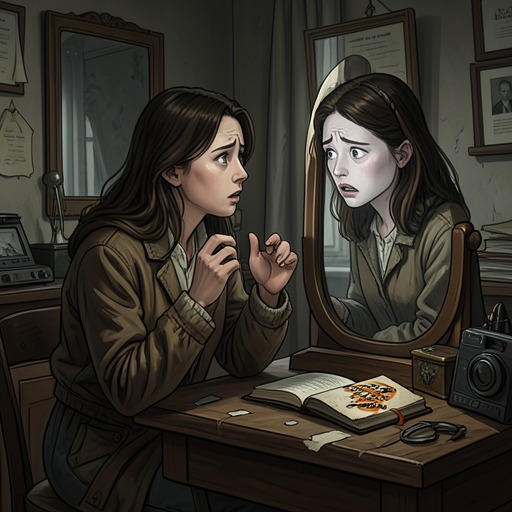
Turtles All the Way DownThought spiral is the book’s image for a recursive process in which Aza Holmes’s fear of infection turns a possibility into an urgent demand for certainty, then renews itself after checking or cleaning briefly eases the distress. The spiral is not simply a succession of worries: each attempted answer supplies another question, narrowing Aza’s attention until ordinary sensations and relationships become material for the same loop.
Definition and Pattern
Aza experiences intrusive thoughts that Dr. Karen Singh calls intrusives; Aza prefers invasives, imagining them as weeds that arrive from elsewhere and spread through her mental landscape. The distinction captures her sense that a thought can feel alien to her wishes without becoming easy to dismiss. Many people may have a fleeting thought of danger, but for Aza an invasive can crowd out other thoughts, leaving her perpetually thinking about it or trying to distract herself from it.
The spiral’s recurring sequence is visible in her response to bodily uncertainty. A sensation or possibility becomes evidence of danger; counterarguments offer temporary reassurance, but their qualifications leave room for renewed doubt. Checking or cleaning can ease the pressure for a short time, yet the relief does not settle the question. Aza soon wonders whether the check was sufficient, whether the feared condition was present after all, or whether another action is needed. The compulsion thus appears not as a solution to uncertainty but as a step that allows uncertainty to restart.
The Cafeteria and the Finger
At White River High School, abdominal noises draw Aza’s attention away from lunch and into fears about the microbial balance inside her. She searches for information about the human microbiome and Clostridioides difficile, reads that most infections occur in hospitals, and compares its listed symptoms with her own. The noises seem to fit, although the other symptoms do not. Remembering a report of someone who died after presenting with abdominal pain and fever, she notes that she has no fever; the thought immediately shifts toward the possibility that one might develop.
The spiral also displaces her from the social scene around her. Daisy Ramirez looks to Aza for a response while eating school pizza and green beans, and Aza only partly follows Mychal Turner’s account of an art project averaging the faces of people named Mychal. Daisy suggests redirecting the project toward exonerated prisoners, whose mug shots could connect the composite faces to race, class, and mass incarceration. While that conversation develops, Aza’s attention moves into a recursive question about whether the microorganisms in a body complicate the idea of a singular self or an author of one’s fate. The shift from a conversation about art and social structures to the microbial composition of the self shows how a spiral can take over even when meaningful human exchange is taking place nearby.
A familiar habit gives the fear a physical focus. Since childhood, Aza has pressed her right thumbnail into the pad of her middle finger, leaving a callus over her fingerprint. Because the skin can crack, she covers it with a bandage to prevent infection; when she worries that infection may already be present, she feels compelled to reopen the wound and press out blood. At lunch, while absorbed by fears about her stomach, she removes the bandage and digs her thumbnail into the callus until the skin opens. The action links an imagined threat to a real wound, making the urge to check part of the bodily problem she fears.
Ritual, Reassurance, and Return
At home, remembering a boy holding her hand and looking at her finger triggers a renewed demand to inspect the wound. Aza recognizes the thought as unwanted and tries to distance herself from it, but doubts about river water and contamination gather around the small opening in her skin. In the bathroom, she studies moisture on the removed bandage under the yellow light. It might be sweat, river water, or a sign of infection; because she cannot establish which, the uncertainty drives further action.
She applies hand sanitizer, washes for the recommended twenty seconds while singing the alphabet, dries her hands, reopens the crack, squeezes out blood, and applies another bandage. The sequence brings a brief shivering release of tension. Yet after what may be two, five, or six hundred minutes, the question returns: whether she removed all the pus, and whether there had been pus at all. The spiral’s defining movement is contained in that reversal. The ritual produces relief, but the memory of relief does not become proof that the danger is gone; instead, doubt reopens the case and calls for another check.
Dr. Singh’s advice offers Aza a different practice: breathing in through her nose and out slowly enough to make a candle flicker without going out. Aza tries to follow it while replacing the bandage, but the thought spiral continues to tighten. She also recalls the instruction not to retrieve her phone and search the same questions repeatedly, yet searches again. The contrast makes clear that recognizing the loop and having strategies for interrupting it do not automatically stop it. Aza can understand the advice and attempt to use it while remaining caught in the cycle.
From Microbes to the Self
The spiral reaches beyond fear of a single infection. When Aza reads about research on kissing, she fixates on the finding that an average kiss exchanges around eighty million microbes and that gut microbiomes appear modestly but consistently altered after six months. Rather than treating the result as detached information, she imagines the other person’s bacteria remaining and multiplying inside her. She pulls away, searches for further information, and becomes overwhelmed by the prospect of a bodily change she cannot reverse. The concern turns intimacy into another occasion for monitoring what enters and remains within her body.
Later, a sentence about the gut-brain informational cycle suggests to Aza that gut bacteria may affect thinking through signals sent between the body and brain. The possibility expands microbial anxiety into doubt about the ownership of thought itself: perhaps the bacteria are affecting her thinking, or perhaps the thought is not hers in the first place. That question echoes the cafeteria’s meditation on whether microorganisms complicate the singular self. The spiral therefore joins bodily vulnerability to uncertainty about agency: Aza wants to choose which thoughts are hers, but cannot simply will the unwanted ones away.
Escalation and Significance
During a late-night check, Aza notices faint blood on the old bandage and reasons that the wound may be bleeding because it has not scabbed over. The reassurance is immediately challenged by the possibility that it is infected. She washes her hands, replaces the bandage, then takes aloe-scented hand sanitizer from the medicine cabinet and swallows some, followed by more. As she feels dizzy and her stomach hurts, the fear turns back toward the possibility that clearing out healthy bacteria could allow Clostridioides difficile to take hold. Even the action intended to make her clean becomes a new source of danger, and the next thought contradicts the one that prompted it.
The spiral’s image gives formal shape to this self-renewing contradiction. Following it inward does not uncover a final point at which doubt ends; the thought keeps tightening, while each attempt at certainty feeds another turn. Its recurrence across the noisy stomach, the finger wound, a kiss, and a scientific account of the gut-brain cycle shows how different experiences can be recruited into the same pattern. The concept makes Aza’s distress legible as more than a sequence of isolated fears: it is a struggle in which attention, interpretation, and attempted relief repeatedly circle back to the question they cannot conclusively answer.